
An Undoing of Ourselves: The Internal Work of Peacemaking
A Reflection from CCESJ Delegation to Palestine & Israel
In Sderot, the first town to have been attacked on October 7th, 2023, we stood at a memorial for those murdered in the neighborhood – twenty twisting olive trees, one planted for each victim. It is a somber and melancholic place, where residents gather in the hushed murmur of collective mourning. Above these trees flies an immense Israeli flag waving formidably between two border walls. The first is adorned with doves, poetry, and prose from the neighborhood's residents, decorated in the vision of a colorful and hopeful future.
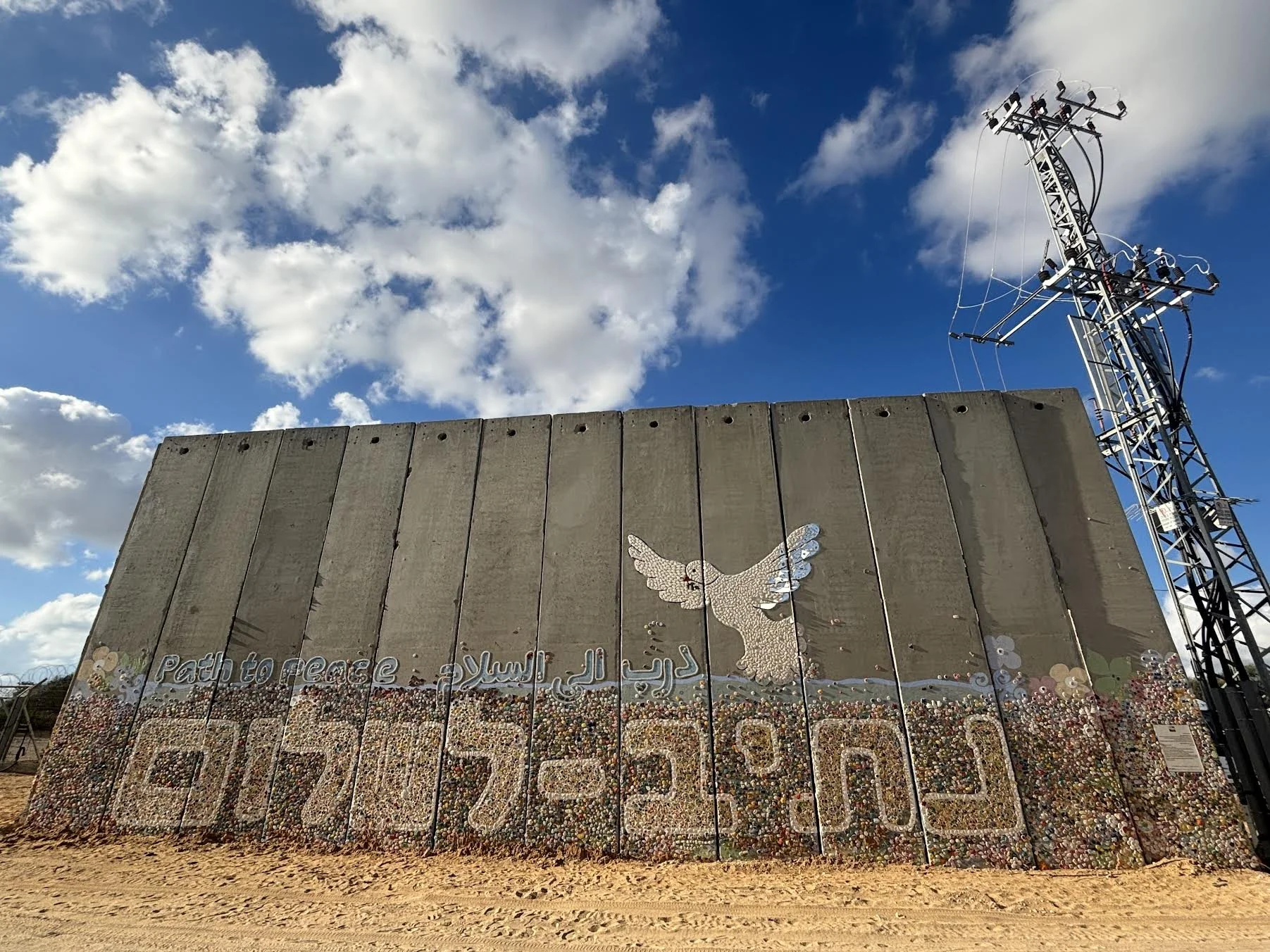
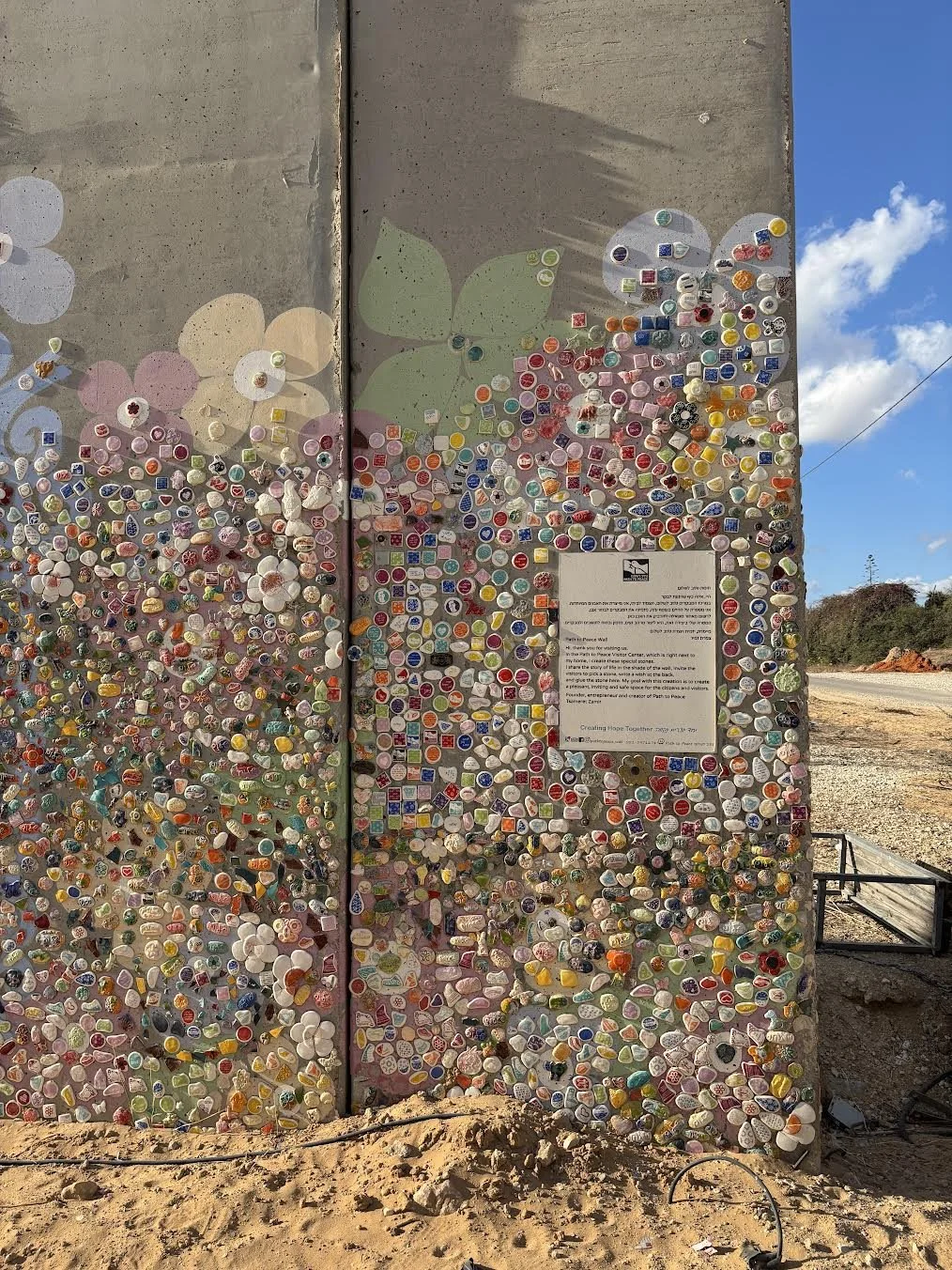
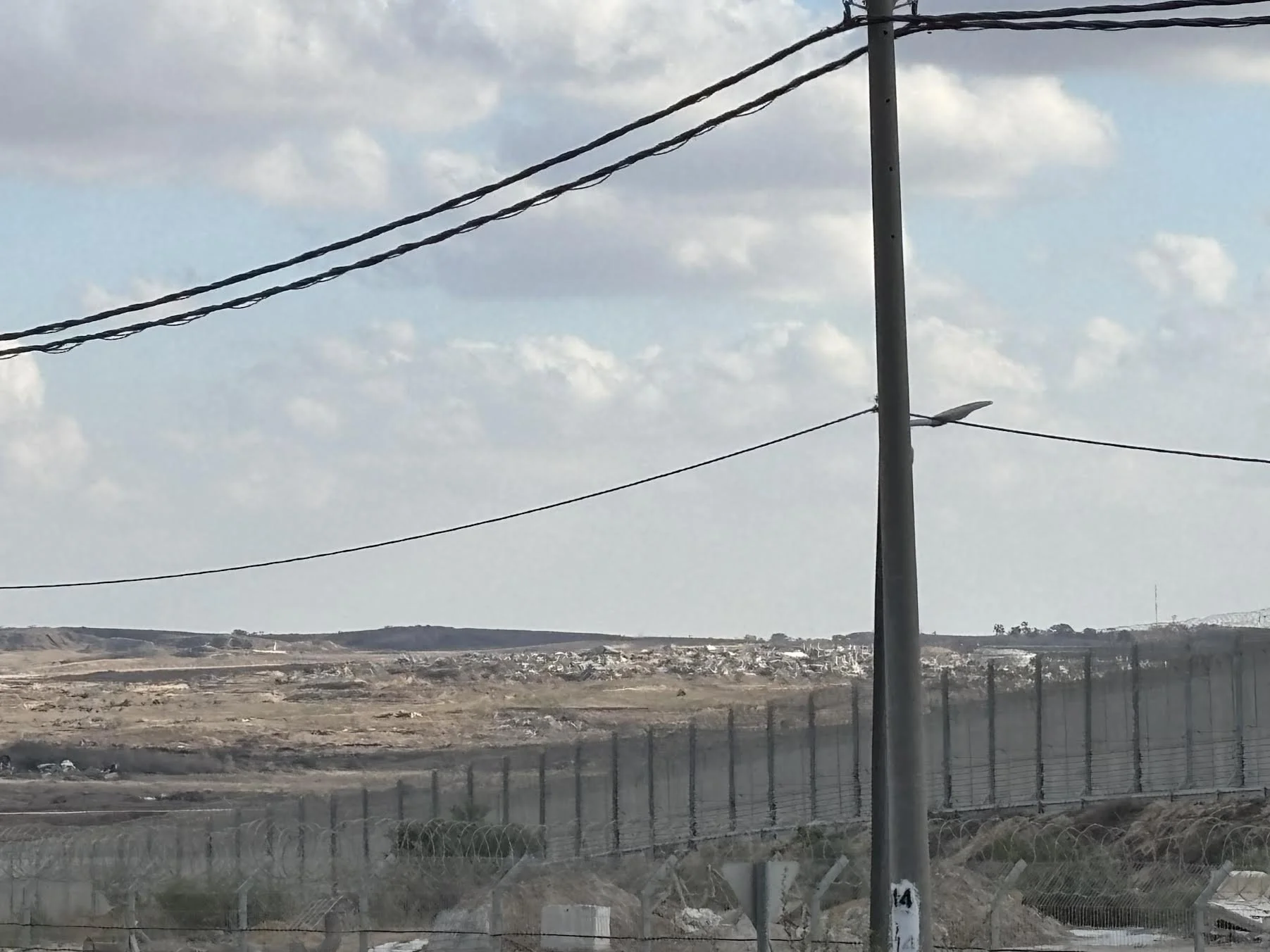
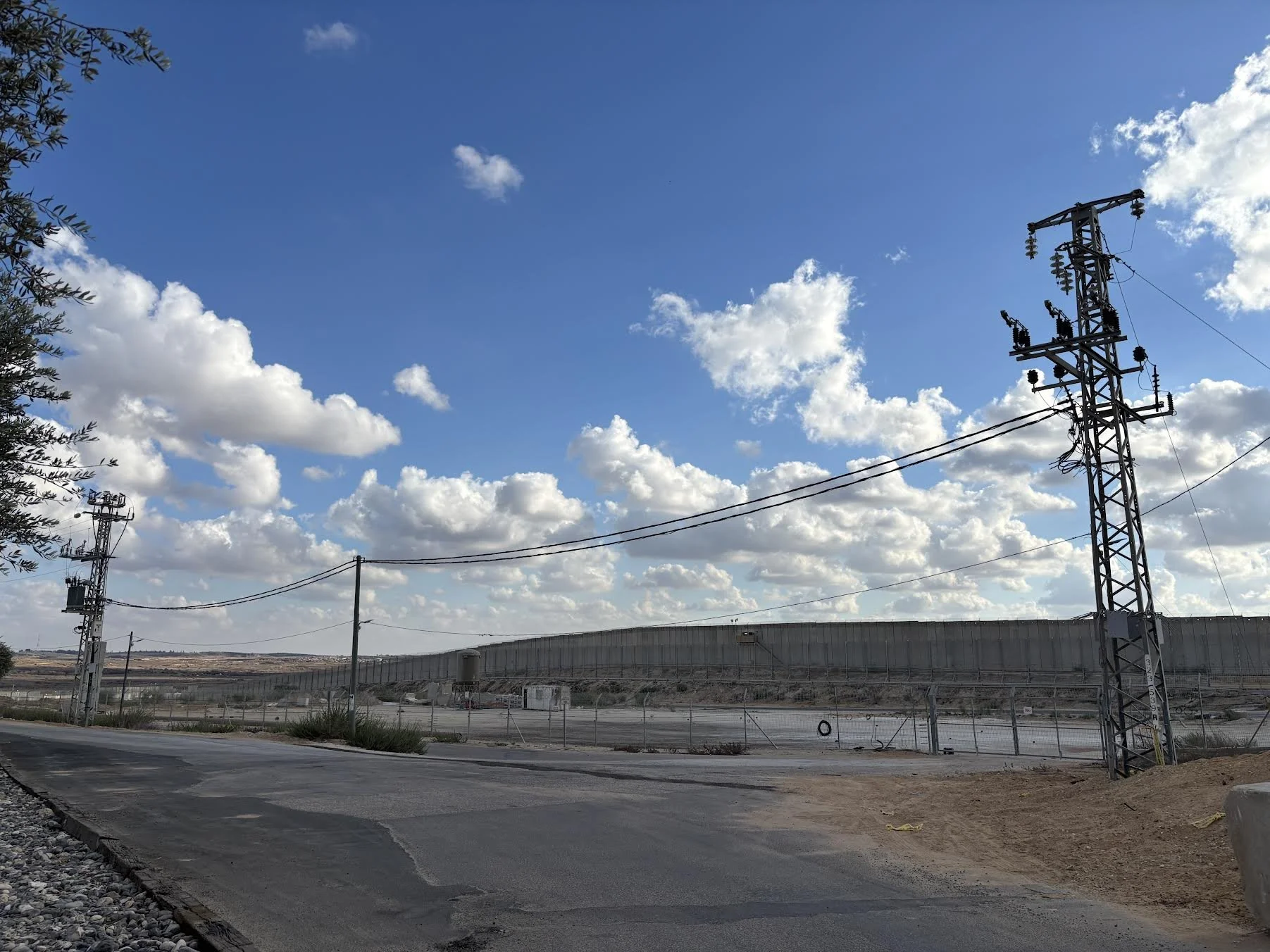
Beyond the second wall is Gaza. From our vantage point, we see no memorials, no trees planted, no names in honor of the lives lost. Instead, there are the tracks of military vehicles, concrete fortified with gun nests and barbed wire, a drone's shrill sound piercing the air above. The scene demands attention, and as it pulls our focus towards it, we cannot look away from the horrifying vision just beyond its barrier: the rubble that is unmistakably an entire Palestinian neighborhood torn to the ground.
Emma Foster’s Op-Ed
The magnitude of what I’m seeing is hard to comprehend. There are hundreds of homes decimated in front of me, and the evidence of lives massacred behind me. The tragedy is palpable, and yet it seems observably disproportionate.
As a member of an interfaith delegation from Union Theological Seminary, I understood and cherished my work to extend empathy to every person we encountered. My faith compels me to remember that every human life is equally precious. Taking in the destruction of hundreds of lives around me, I experienced a grief for all life lost or devastated over these last two years.
The challenge was not maintaining my empathy for every individual life destroyed. The challenge of that moment was reckoning with whose death was viewed as a tragedy, and whose deaths were justified as compensatory. Empathy is made more complicated when the pound of flesh extracted for the 1,200+ Israelis murdered on October 7th has come in the form of over 70,000 Palestinians slaughtered. The imbalance is hard on the heart muscles. That is mine to resolve and carry, of course, but I felt my compunction profoundly as I stood amongst the planted olive trees of mourning, staring into an impenetrable scene of unsanctioned grief.
Our trip coincided, unintentionally, with the announcement of the ceasefire deal for the 20 living Israeli hostages to be released. There was, naturally and rightfully, a nationwide celebration in Israel for the citizens being returned to their homes and families. That same day, nearly 2000 Palestinian prisoners and hostages who had been held under Administrative Detention were released as well. Yet Israel explicitly told the families of those returning that they could not publicly celebrate.
There is the heartbreak at Palestinian deaths not being recognized as tragic, but there is an entirely different heartbreak at Palestinian life not being seen as worthy of celebration. Israel has annexed nearly every element of Palestinian life, even joy, to serve the prosperity of its own citizens. Of course, the Israeli people deserve safety. Every human life is sacred and worthy of protection. But the extent of the violence enacted in the name of Israeli safety, a genocide as confirmed by even respected Israeli sources, is indefensible.
I stood between these two walls, feeling my heart pump unevenly, one side so weighed down by the tens of thousands of lives lost on the side of the wall I could not reach. Even as I found myself most sympathetic to those who have suffered disproportionally, what became clear was the hypocrisy of my own American identity. I cannot pretend not to understand the allure of someone wielding my safety as an excuse for disproportionate violence. I have lived my entire life as a white person in the United States of America. The promise of American dominance, our power over other nations, has been a central pillar of my assured security. If I am radically honest, such a sense of dominion has made me feel safe. This realization demanded reflection: What have I believed in the name of my own security? What conditions have I accepted for others to serve my own comfort?
My understanding can, of course, only extend so far: I do not have the experience of epigenetic trauma, passed down through thousands of years of persecution, nor am I currently confronting internationally rising tides of antisemitism that threaten me, personally and politically.
Where I see our similarity is in the cultivation of fear. I have had a fear stoked in me by a narrative that my safety is predicated on the sacrifice of another. This fear has been used to manipulate me into believing that the means justify the ends. I, too, have been told the story that it is them or me and believed it.
We are all morally responsible for the consequences of our fear. Our fear cannot excuse us or be considered a reasonable explanation for actions that harm a perceived or prescribed threat. If there is to be a true vision of peace, one that does not glitter with a hollow rhetoric of calm and quiet, but is grimy with the hallowed work of justice and solidarity, a first step must be stripping ourselves of any notion that fear is an absolution. It does not exonerate us from our accountability to one another. We cannot continue to prioritize our feelings of unsafety over the embodied realities of such a fear being weaponized to violent and inhuman extents.
Gisell Rondon’s Op-Ed
Landing in Tel Aviv brought the immediate experience of being profiled at Israeli customs, a moment that was, perhaps naively, unexpected. I found myself abruptly redirected and isolated from our group, prompted to answer probing questions about my family’s religious upbringing, my occupation, my origins, and my exact purpose for this trip.
Something happens once you are on the receiving end of suspicion, particularly from a state official: a startling moment of bewilderment, the fleeting shame that emerges when guilt is cast upon you, and the unyielding clarity that something is clearly wrong. As I was interrogated, I remember thinking: whatever is operating beyond this brief moment must give way to a much larger, sophisticated, and insidious system of racial and ethnic profiling, prejudice, and targeting of Palestinians in the territory. This unexpected welcome (one that was incredibly mild in comparison to the daily experiences of Palestinians in the territory and throughout the diaspora) colored my experience and interactions during my week in Israel and Palestine with our interfaith delegation from Union Theological Seminary. Throughout the week, I became hyper-aware and vigilant of how I was being perceived, looked at, and read – something that isn’t particularly new to me as a woman of color – but that took on a different form as I began to try to understand the logic of the Israeli government, Zionist ideology, and the tense yet delicate relationship between Israeli-Jews and Palestinians.
Throughout the week, the question of peace-building was at the core of our reflections and conversations as we met with leaders, educators, and activists from both Israel and Palestine. “How can we work towards peace in times of global unrest? How can we maintain kindness and respect for each other despite our differences? How are we called to confront conflict without resorting to hurting and maiming each other?” These questions, which attempt to ground our aspirations as scholars and faith leaders and allow us to dream of a utopian future, often felt insurmountable in the face of the state-sponsored violence that was on display before us. Relentless checkpoints, watch towers, and apartheid walls were a constant reminder of the imposing power of Israeli militarization and its fervent efforts to keep communities separate and surveilled.
In particular, the walls between Sderot and the Gaza Strip offer an uncompromising view into the daily function of what queer Chicana philosopher and scholar Gloria Anzaldúa would call the “open wound” of borderlands, providing a visual and symbolic landscape for the forceful splintering of Israeli and Palestinian subjectivity into what seemed like two detached planes of existence. There is a stark difference between the substantial militarization and destruction within the perimeter of the Gaza Strip and the sheltered site of tranquility in which Israeli residents gather to mourn and remember their loved ones. These two chasms of profound grief, so close in proximity yet estranged from each other, were haunting. Namely, due to how the precious ritual of remembrance was within arm's reach for local Israeli residents, working to gently heal the wound of their losses, while just a couple of hundred feet away, the debris and wreckage of what used to be a Palestinian neighborhood on the other side of the wall remains suspended within a void of namelessness and the denial of public memory.
The paradoxical nature of this encounter triggered a series of questions for me: What happens to your life when your death is not mourned or remembered? Whose death is sacred in the eyes of the Israeli government? How do these border walls effectively render a site of such suffering and tragedy for Palestinians, ordinary and inconsequential?
I vividly understood at that moment that the rubble, the barbed wire, the guard towers, and the shrill sound of drones overhead were not symbols of disruption, discomfort, or surveillance for neighboring Israelis, but perhaps presented as necessary guardrails for peace, safety, and stability. One Israeli peace activist named this feeling, stating, “For now, we need the military to be here until it is safe for us. Right now, it is not safe.” It is through these state-sponsored tools that I saw a physical manifestation of what peace, packaged for the Israeli perspective, looked like; one that relied upon these tactics that exacerbate the Palestinian struggle. This vision is conceptualized in pastel tones of harmony and civility, manifesting into a fragile idea where peace becomes conditional and fueled by the fear and psyche of Israeli-Jews who are still reeling from the trauma of persecution and genocide, the events of October 7th, the rise of global antisemitism, and the corrupting nature of Netanyahu’s right-wing conservatism, which prioritizes exploiting terror and paranoia in order to breed more extremism, distrust, and division between Israelis and Palestinians. It is a vision of a bleak future in which safety remains a scarce commodity, reserved only for those who pay the price to align themselves with the moral rot of demagogues who selfishly pursue power and supremacy.
We must have a critical and robust conversation about what the liberating work of peace entails. The messy, selfless, unraveling function of peace-building is at its best when it refuses to compromise one person’s humanity at the expense of another’s. There is something that must be undone, profoundly destabilized, and reconstructed within us and the social fabric in which we live, in order for true peace to become possible. It cannot simply be built upon already existing structures of state violence. Peace cannot be manufactured through flimsy facades of civility or tactics that silence and stall the cries of those who are disproportionately suffering; nor can it be offered as a cheap solution to quell the despair of those who are in fear. We must confront that the praxis of peace – that is to say, the work that makes peace possible – is one that is far from romantic and picturesque visions of harmony. It does not include doves nor glitter, but rather demands turbulent confrontation and ushers in accountability, the democratization of political and economic power, the courageousness of solidarity-building, and the spiritual process of grief. Without this work, which firmly threatens to undo the status quo of apartheid within an Israeli ethno-state and instead lives by the principles of universal dignity and interconnectedness, our visions for peace become as futile as fairy-tale illustrations in the face of relentless carnage and dehumanization. To commit to peace requires us to face this carnage, to learn from its pain, and to account for it through systemic change and healing – not only for Palestinians under the boot of the Israeli government and military, but for all oppressed peoples around the world.
Conclusion
“So what are Palestinians supposed to do in the meantime?” Our tour guide, Layla* asks. She is a Palestinian herself, courageously and empathetically engaging in conversations of peace-making with those across a wide spectrum of beliefs about the sanctity of her people. At this moment, we were speaking with a self-identified liberal Israeli-Jew, staring out over a valley in Jerusalem, the Red Sea on the horizon.
“I think they should wait,” our Israeli tour guide, Sam*, responded. He makes a plea for non-violence under the proposition that delaying confrontations between Palestinians and Israeli-Jews would allow for Israeli fear and despair to subside, and inspire a willingness to work towards a peaceful solution.
“That’s impossible,” Layla candidly responded. She goes on to explain that it is an entirely unfeasible proposition to expect Palestinians to passively accept the conditions of their own oppression and state-sanctioned death. We would argue that it is also a historically unsupported premise – that accepting one’s own systemic oppression would lead to anything other than continued oppression.
It is a remarkable interaction to watch unfold, one in which a privileged citizen of an apartheid state could casually tell the recipient of such power imbalance to defer action and wait until their own fear subsides, on a timeline that feels comfortable to them. The value our guide placed on a nonviolent path forward is one we share, but his proposed timeline for such movement forward is untenable, and the impetus for it based solely on the unpredictable sensation of feeling ready. It is impossible, at least if one yearns to maintain the dignity inherent and sacred to human life, to wait for peace to be granted to you as you wade through perilous conditions of occupation that actively damage your life.
We are interested in interrogating the fear so honestly felt by Sam and others we met in Israel. There are contours of personal loss, death, and grief that many Israeli-Jewish people have experienced, as well as the influence of Zionist ideology and citizen-identity, that make up this fear. We know the resultant embodied fear is palpable and must be examined.
What we do find impossible ourselves is the expectation that one must feel totally safe before one is willing to collaborate in the work of solidarity and justice. Can that ever be possible? In our classrooms, we have moved away from the concept of a “safe space” to a “brave space,” because it better acknowledges that there is always risk in honesty. If that is the expectation on this scale, how can we ever justify demanding an entirely “safe space” when the conditions of that safety are predicated on maintaining the routine of violence and subjugation? As one waits to feel safe, how many people will die from the status quo? As one waits to feel safe, who must undergo the embodied impact of delayed safety? Furthermore, as one waits to feel safe and neglects the work of building trust with those perceived as a threat, how can one ever reasonably expect the relationship to change?
There is a fallacy that time changes things. The Rev. Dr. Martin Luther King Jr. reminded us in his 1964 City Temple Address that time itself is neutral. “It can be used either constructively or destructively. And I must honestly say to you that I'm convinced that the forces of ill will have often used time much more effectively than the forces of goodwill. And we may have to repent in this generation, not merely for the vitriolic words and the violent actions of the bad people, but for the appalling silence and indifference of the good people who sit around saying, ‘Wait on time.’”
We know there can be no waiting to enact justice. The time is not coming: we are tasked with the work of justice now, every day of our lives. Palestinians deserve freedom, dignity, peace, agency, joy - now. We know this.
If we know these things to be true, how could we ever privilege the fear of those who garner a sense of safety from the destruction of another? How do we move forward without negating their feelings of fear, yet move forward all the same? How do we walk with this fear – taking the parts that are true and tending to it, uprooting the parts that are untrue, planted like an invasive entity?
Fear is a credible, important, and necessary entry point into much of the hardest interpersonal work we’ll ever do. Yet for as natural and important an instinct as fear is, its embodied impact is to centralize our survival instincts on ourselves. So it cannot, for any moral being, be the endpoint.
We have the responsibility to examine our fear to determine what is true, to honor it as a reminder of our own vulnerability and sacredness. So too are we responsible for examining what of it is not true: what of our fear is amassed through implicit biases, what is based on lies, deceitful rhetoric, or a reductionist view of history. Fear has been so manipulated and totalized, because the influence of fear fuels our division and benefits those for whom community and collectivity would deplete their power or purse. We are responsible, individually and collectively, to interrogate fear. And when that fear is having a damaging impact (which it nearly always does), we are charged with transforming it.
So we begin with the excavation, cutting away the pieces of our fear that have been handed to us and tending more gently to the elements of our fear that are valid. From this place of compassionately tending to ourselves, we better equip our hearts for that same work with others. We have prepared ourselves to enter “brave space,” because we are not solely concerned with the self-protection our fear has insisted on. Instead, we can move from fear to concern. We can consider our place within the interconnected fabric of all people. For as sacred and as valuable as our natural instincts of fear remind us we are, so too is every person sacred and worthy of safety.
We are charged with shifting our fear to concern, to move beyond our survival instincts and our gut reactions into the spaces of our hearts and minds. Concern is a collective orientation, one that acknowledges our own preciousness as much as every other person it concerns itself with. It is a capacious enough framework to allow us to begin to work together before there is any indicative sensation of safety.
Concern is plural and it is cognizant. Fear, left unfiltered, only ever leads to isolation. And such isolation rots the spirit and allows for one to accept, and even condone, violence against those at the root of one’s fear. Concern is a collective project, one that acknowledges and prioritizes our interconnectedness. It preoccupies itself with the highest good for all. We are charged, as people of conscience, to transform our fear into concern so as to honor what we know to be true: that every life is equally precious.
It is our moral responsibility to honor our interconnectedness and to consistently expand our capacity to hold the complicated, conflicting, and liminal nature of multiplicity in our lives. To try to deny this connection and cauterize our ties to each other is to shut ourselves off from our capacity for goodness toward each other, and ultimately toward ourselves.
While the thought-exercise and theological thread of interconnectedness may seem, to some, as naively optimistic as the same glamorized visions of harmony we critiqued earlier, it is important to note that the practice of interconnectedness as a framework for justice directly confronts the institutionalization of isolation, apathy, and fear. Fear and extremism are not just moral attitudes or outlooks; they are systematized ideologies that seek to preserve distance, misunderstanding, and polarization between us. These are myths that convince us that individualism is the only thing that will keep us safe and help us survive. Such isolation creates borders, fuels conspiracies, and embeds harmful markers of legitimacy and illegality in our bodies, fostering uncertainty and mistrust.
Thus, in the practice of interconnectedness, we are called as humans to be involved and participate in one another’s lives across borders, across these markers of dehumanization, across conspiracies and fear and mistrust. This is an appeal for internationalist solidarity, a responsibility not to let the engulfing systems of capitalism and imperialism cut off the life source of empathy, and our obligation to witness and participate in each other’s lives.
There is a different avenue we can build, one in which empathy gives way to accountability. To deeply understand how one another feels and experiences their daily lives, to temper our most imperfect human instincts, and nurture them in a way that is transformative. It might be impressed upon us that it is too romantic to think that our salvation is in community, that only the strong-armed and violent forces of capitalism, militarism, and imperialism can truly function in a world that is already so turbulent and cruel.
We must hold onto the hope that there is another path forward, another way of living and being in this world that makes liberation possible. This work requires a different kind of strength, a sturdiness that does not rely on arms, tanks, or walls, but rather on our own capacity to confront our deepest insecurities, our suffering, and the vulnerability of our fears and hopes alongside others. It is in our conscious choice to remain connected to each other, even when our most primal instincts urge us to run away and protect ourselves, that we can build a reality of peace that liberates every human life. May this work begin between the border walls of Gaza and Sderot, and extend to every place in the world where violence and subjugation are the expectation.